
What Quantization Involves
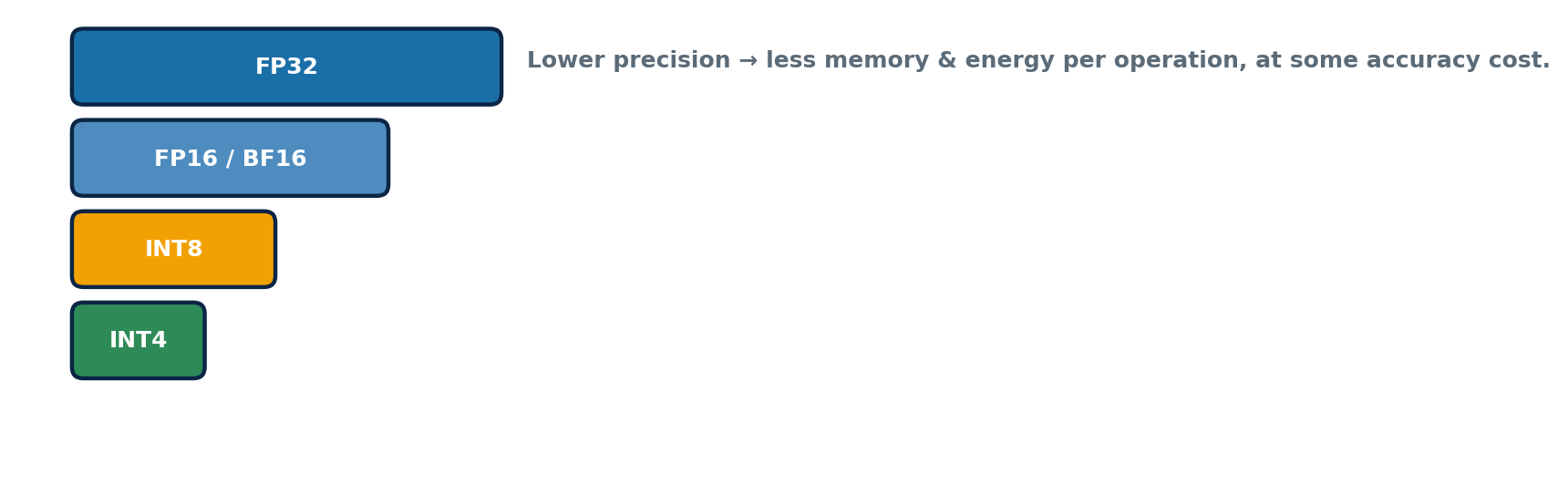
Common formats range from 32-bit floating point (FP32) down through 16-bit formats (FP16, BF16), and further to 8-bit or even 4-bit integer formats (INT8, INT4). Each step down in precision roughly halves the memory needed to store the same data and reduces the energy cost of each arithmetic operation, but can also reduce the numeric accuracy of the computation – a trade-off that must be validated against the specific neural network and application.
Why It Matters
Because memory movement often dominates energy consumption in AI accelerators, reducing precision doesn't just save compute energy – it directly reduces the data volume that needs to move through the memory hierarchy. Well-chosen quantization can dramatically improve performance-per-watt with little to no measurable impact on the network's actual output accuracy.