

What the Two Approaches Involve
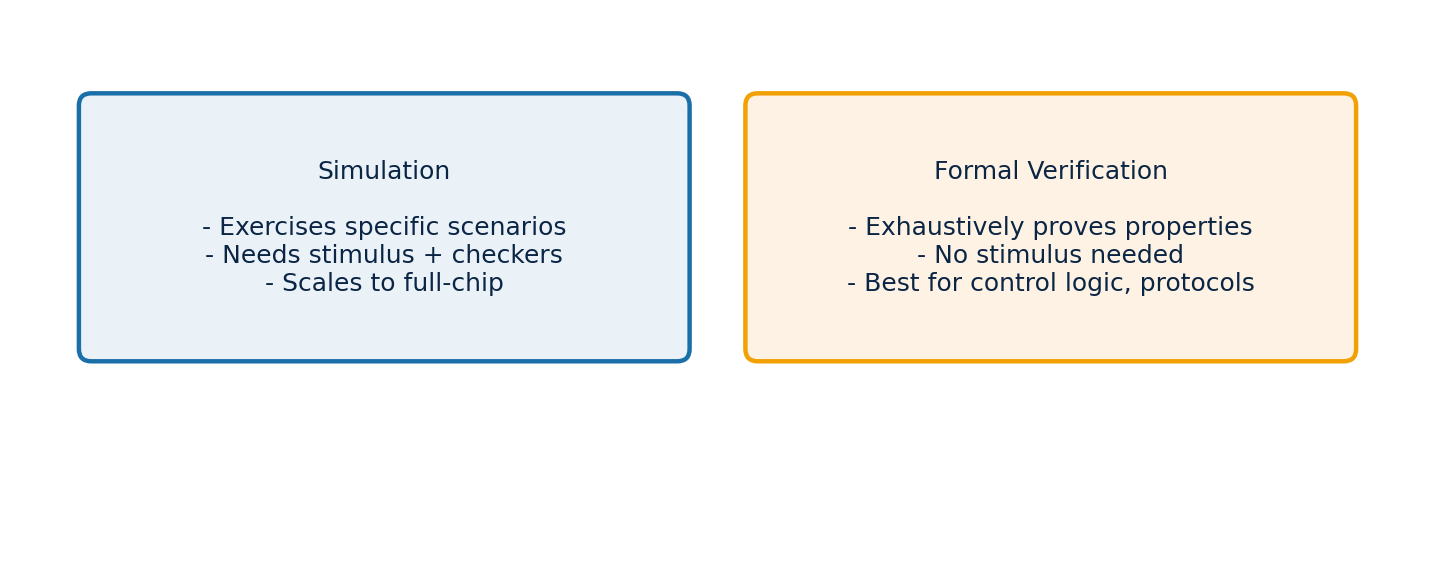
Simulation runs specific test scenarios against the design and checks the results, scaling well to large, full-chip designs but only covering the scenarios actually tested. Formal verification instead uses mathematical proof techniques to exhaustively check that certain properties always hold, across all possible inputs and states – without needing any test stimulus at all. This makes formal especially powerful for control logic, protocol compliance, and proving the complete absence of certain bug classes.
Why It Matters
Formal verification can find corner-case bugs that would be nearly impossible to hit through random or directed simulation, particularly in complex control logic and arbitration schemes. However, it doesn't scale well to entire large designs the way simulation does. Most verification plans use formal for targeted, high-value blocks and simulation for broader, system-level coverage.