

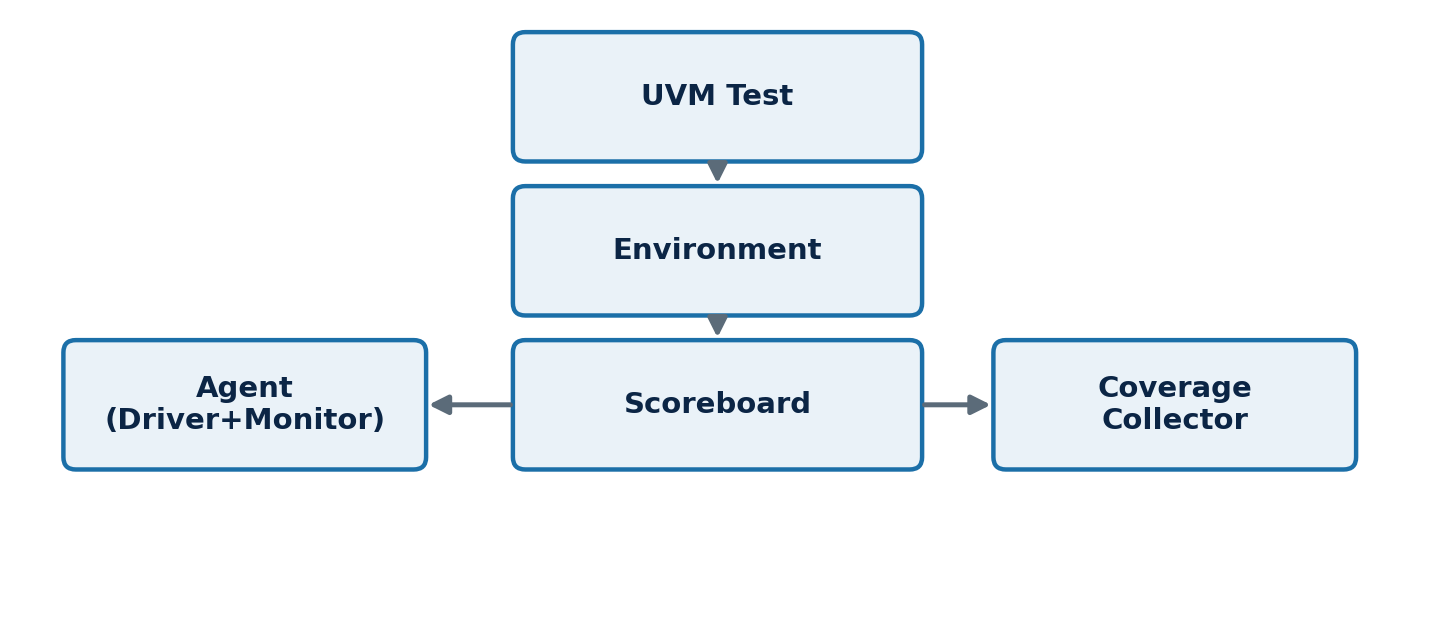
What UVM Testbenches Involve
A UVM testbench is organized as a hierarchy of reusable components. Agents contain drivers (which apply stimulus to the DUT) and monitors (which observe DUT behavior). An environment assembles one or more agents along with a scoreboard, which checks that DUT outputs match expected behavior, and a coverage collector, which tracks which scenarios have been exercised. Tests sit on top, configuring the environment and directing specific stimulus sequences.
Why It Matters
This layered, component-based architecture is what makes UVM testbenches reusable across projects and scalable from block-level to full-chip verification. A well-built UVM environment can be extended with new tests and coverage goals without having to rebuild the underlying infrastructure each time.