
What This Decision Involves
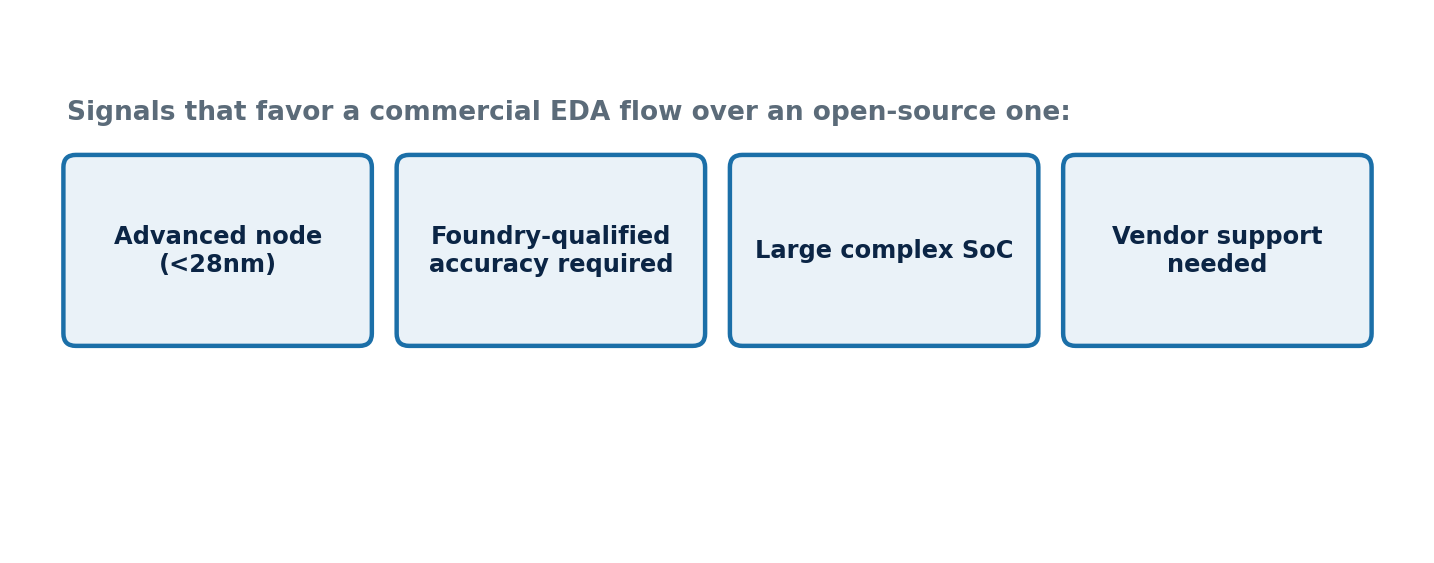
Advanced process nodes (below roughly 28nm) generally require commercial tools, since open-source flows and PDKs haven't yet matured to support them. Projects that require foundry-qualified signoff accuracy – a hard requirement for many commercial tape-outs – typically need commercial signoff tools that carry that qualification. Very large, complex SoCs may also benefit from the more mature congestion and timing optimization capabilities of commercial place-and-route tools, and projects requiring dedicated vendor support and training may value the commercial ecosystem around these tools.
Why It Matters
Choosing an open-source flow for a project that truly needs commercial-grade capability can lead to schedule risk, difficulty reaching timing or DRC closure, and challenges getting foundry sign-off. Recognizing these signals early avoids costly flow changes mid-project.