

What SoC Architecture Involves
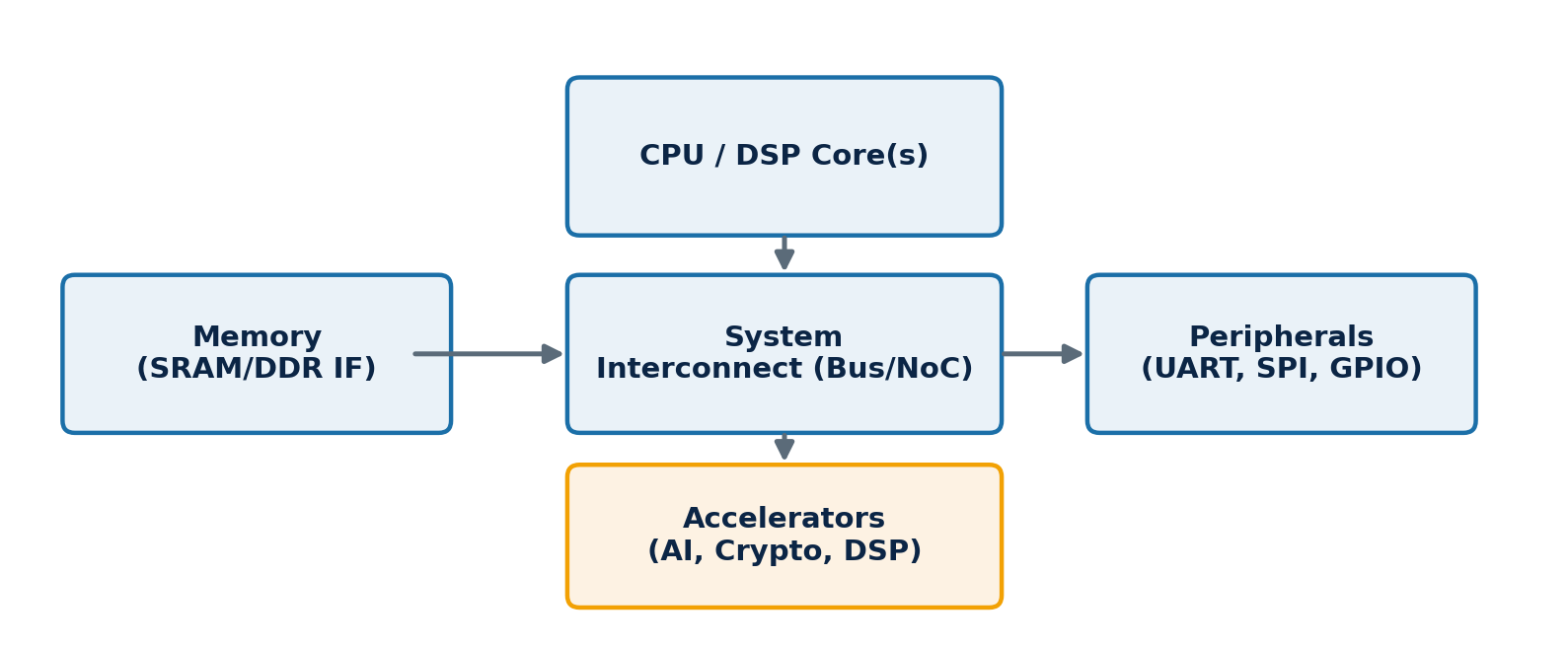
At the center sit one or more processor cores (CPU, DSP, or microcontroller). Memory blocks provide working storage, ranging from on-chip SRAM to interfaces for external DRAM. A system interconnect – a shared bus or a more scalable Network-on-Chip (NoC) – moves data between all these blocks. Peripherals handle communication with the outside world, and dedicated accelerators offload specialized, high-throughput tasks like AI inference or cryptography from the general-purpose cores.
Why It Matters
The choice of interconnect topology, memory placement, and accelerator integration determines how well an SoC actually performs under real workloads – not just in theoretical peak numbers. Bottlenecks in the interconnect or memory system are some of the most common reasons real-world performance falls short of the datasheet.