

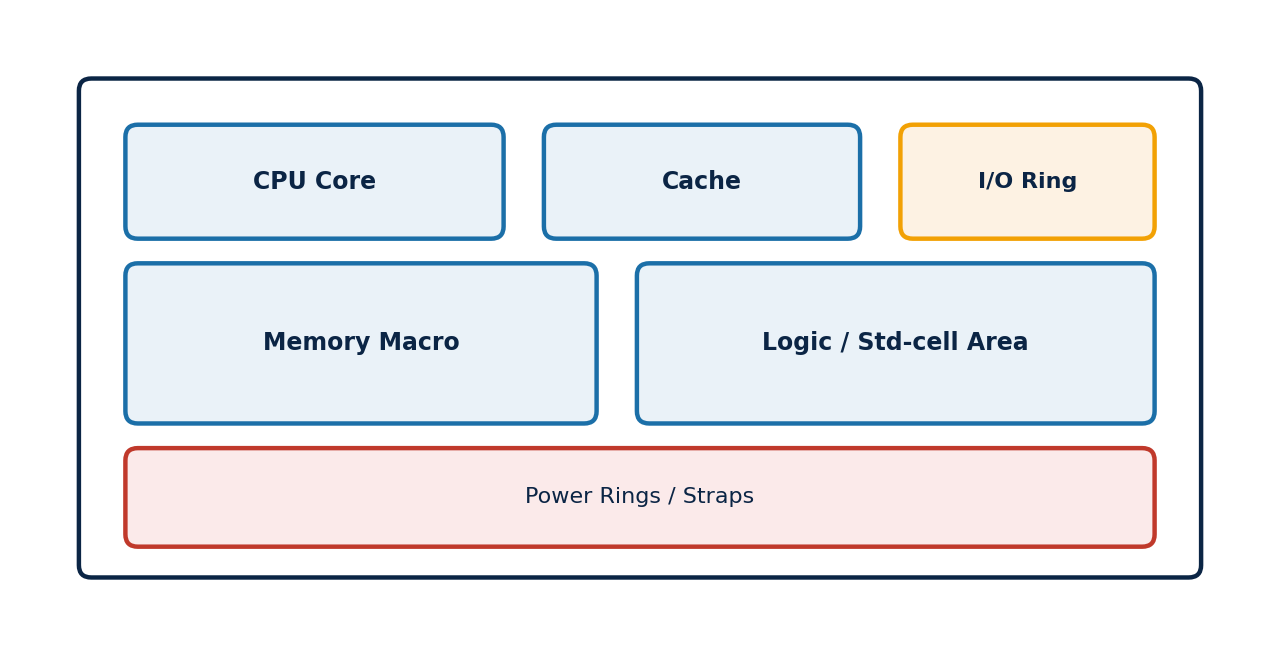
What Floorplanning Involves
Engineers position large blocks (processor cores, memory macros, accelerators) to minimize wire lengths between frequently-communicating blocks, while leaving room for I/O connections around the chip's periphery. Power ring and strap structures are planned to deliver stable power across the whole die. Good floorplans also account for thermal considerations, keeping high-power blocks appropriately spread out or near effective heat dissipation paths.
Why It Matters
A poor floorplan creates long wire routes between critical blocks, making later timing closure far more difficult – sometimes impossible without a full floorplan rework. Since floorplanning happens early, mistakes here are expensive to fix later, making it one of the highest-leverage stages to get right the first time.